
· Life Hacks · 6 min read
What Is Textured Soy Protein, and Why Does It Chew Like Meat?
Look closely at a strip and you will see fibres in parallel. That is not shaping — it is why the product chews, holds flavour, and carries 23.9g protein.
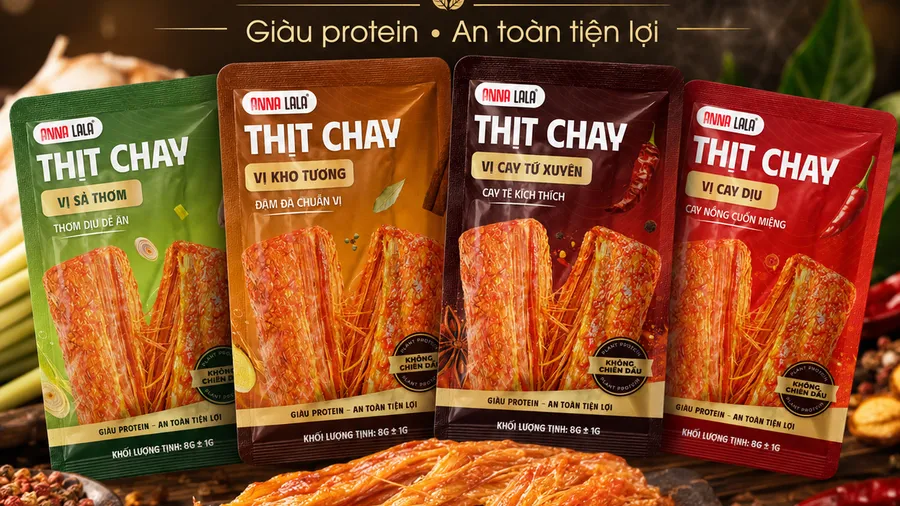
Pick up a strip of vegetarian meat and look at it closely. It isn’t a solid block. It is made of fine fibres running in parallel, which pull apart in your fingers, and which give a springy, resistant chew rather than crumbling.
That fibrous grain isn’t a decorative touch. It is the entire reason the product eats like meat — and it starts with the first name on the ingredient list.
The first ingredient tells you nearly everything
The ingredient list for ANNA LALA vegetarian meat opens with: textured soy protein.
Ingredients are declared in descending order of weight, so leading the list means this is the largest component by some margin. Everything after it — water, sugar, vegetable oil, maltose syrup, fermented soy sauce — is the seasoning base that clings to it.
The word doing the real work is “textured”. Soybeans have no fibres of their own. The fibres are manufactured.
How soy protein is made to form fibres
To see why this works, you have to picture the protein in its original state.
Inside a soybean, protein molecules sit coiled up into compact little spheres — think of separate balls of tangled yarn, each one self-contained and not joined to its neighbours. Nobody mistakes a plain soybean for meat, because there is no structure there to give resistance.
Texturing does three things, in order:
1. Unfolds the protein. Under high heat combined with pressure, those coiled balls open out into long chains. This is denaturation — the same process that turns an egg white from clear to opaque in a hot pan.
2. Lines the chains up. The unfolded mass is forced through a narrow opening. Flow through that gap drags the chains into alignment with the direction of travel, the way tangled hair falls parallel once it is combed in one direction.
3. Locks them in place. On the far side of the opening, pressure drops abruptly. The chains, now lying parallel, bond to one another right where they are, fixing the fibrous grain permanently.
What comes out is a protein mass with a grain — strong along one axis, easy to separate across it. Exactly like a cut of meat.

Why “parallel” is the detail that matters
This is the crux of it, and it comes down to how real meat is built.
Animal muscle is a bundle of thousands of fibres lying side by side. That is why a cut of meat has a grain, and why cooks care about slicing with it or against it: cutting across the grain severs the fibres and the meat eats tender, while cutting along it leaves them intact and the meat eats chewy.
The springy resistance you feel when chewing meat is your teeth breaking bundles of fibre one at a time, not grinding through something uniform.
So making plant protein eat like meat takes more than getting the flavour right — you have to rebuild that arrangement. Tofu is also made from soy and is also rich in protein, yet nobody confuses the two: tofu’s protein sets into an undirected mass, so it yields softly and breaks apart instead of resisting and shredding.
Same raw material. The difference is entirely in how the molecules are arranged.
The fibres explain something else: why it takes on flavour
Notice that all four flavours — lemongrass, braised soy sauce, Sichuan spice and mild chilli — are built on the same textured soy protein base, differing only in the seasoning added.
That works because a fibrous mass isn’t solid. The gaps between the fibres form countless channels that carry seasoning deep inside rather than leaving it sitting on the surface. The contact area is far greater than a solid block of the same weight would offer.
It is also why a strip weighing only a few grams still tastes emphatic.
The numbers: high protein, low fat
Set against instant eggs, the catalogue’s other protein-led product, the comparison is clear:
| Per 100g | Vegetarian meat | Braised egg | Salted egg |
|---|---|---|---|
| Energy | 206 kcal | 237 kcal | 232 kcal |
| Protein | 23.9 g | 18.3 g | 14.2 g |
| Fat | 4.5 g | 15.0 g | 19.0 g |
| Sodium | 1014 mg | 792 mg | 1210 mg |
Vegetarian meat leads on protein and sits lowest on fat across all three columns. The gap on fat is the striking one — roughly a quarter of the salted egg’s figure.
None of which is surprising: an egg carries its fat in the yolk, whereas here the fat comes mainly from the vegetable oil in the seasoning.
One figure that invites the wrong conclusion
Look at that sodium column and 1014 mg per 100g reads high. This is where the pack weight needs reading carefully.
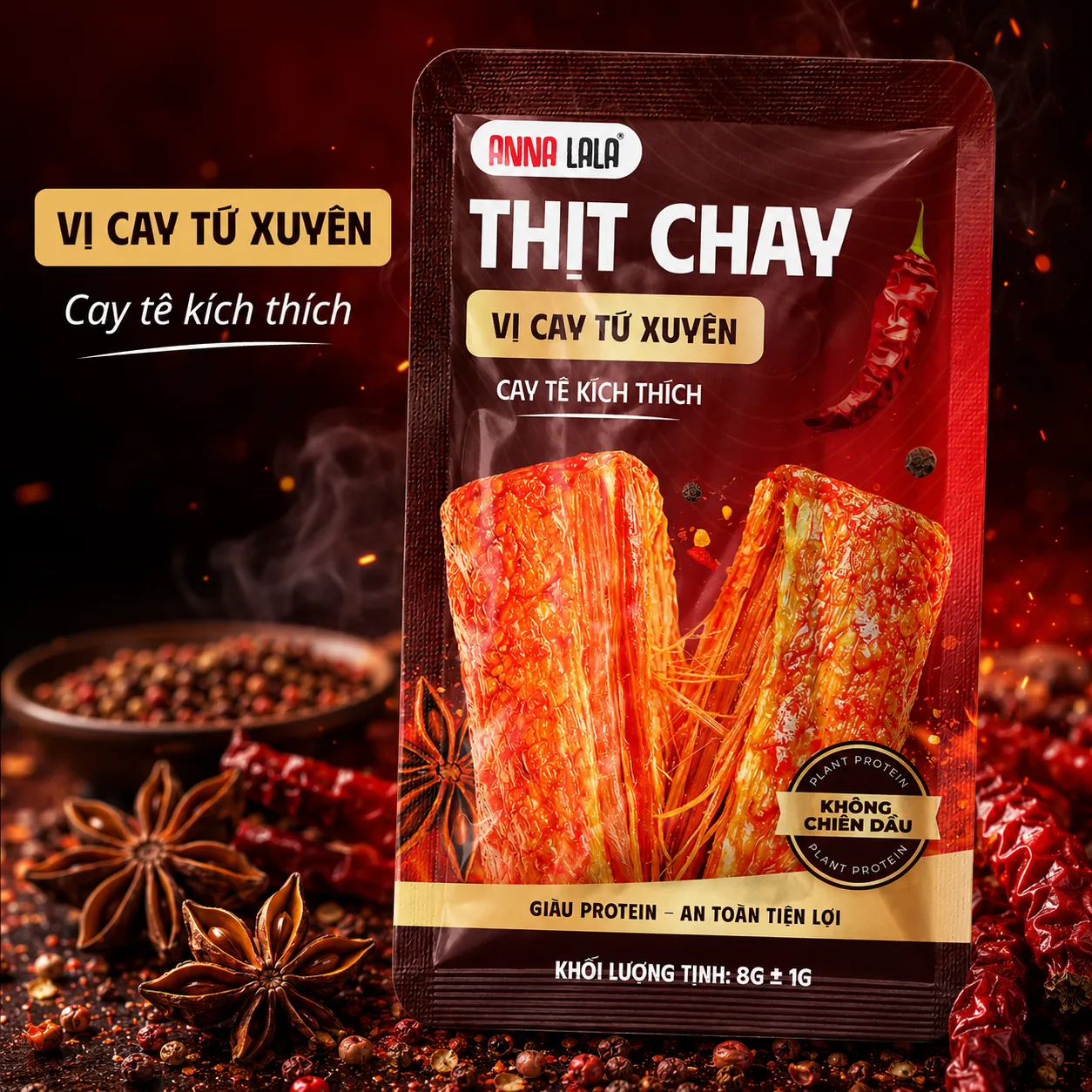
A pack of vegetarian meat weighs 8g ± 1g — considerably smaller than anything else in the range. Converted to what you actually open:
| Per 8g pack | Amount | Share of a daily intake |
|---|---|---|
| Energy | ~16 kcal | under 1% |
| Protein | ~1.9 g | — |
| Fat | ~0.4 g | — |
| Sodium | ~81 mg | ~4% |
To be straightforward about it: the per-pack numbers are small because the pack is small, not because the product is mild. Measured per 100g this is still firmly a savoury item. Five packs put you roughly level with one pack of chicken feet on sodium.
The honest reading is that 8g is a small, self-limiting portion — useful when you want a hit of something intense without taking on much — rather than a licence to eat freely because the calorie figure looks low. The case for comparing by the pack instead of by 100g is set out in which snack has the fewest calories.
So is it “healthier” than meat?
This piece is about structure and isn’t trying to settle that — and in truth there is no single answer to it.
What the figures do support: more protein and less fat than the instant eggs, entirely plant-based and therefore free of cholesterol. What the figures equally show: it contains sugar (11.5g per 100g), sodium at savoury-snack levels, and additives — flavour enhancer INS 635, preservatives INS 202 and INS 282, and caramel colour INS 150d within the fermented soy sauce.
It is a snack, not a health supplement. The wider question of eating plant-based is taken up in is a vegetarian diet bad for you.
Frequently asked questions
What is textured soy protein? Soy protein that has been worked with heat and pressure so its molecules unfold, align in parallel and bond back together into a grained structure, imitating how muscle fibres are arranged in meat.
Is vegetarian meat just tofu? No. Same starting material, entirely different processing. Tofu’s protein sets into an undirected mass, so it is soft and breaks apart; textured protein has a grain, so it resists the bite and shreds.
Why is it chewy without a texturising additive? Because the chew comes from physical structure — protein chains lying parallel and bonded to one another — rather than from any ingredient added to create texture.
How much protein does it contain? 23.9g per 100g as declared. For an 8g pack that works out at roughly 1.9g.
Is the product vegan? Yes. The ingredient list contains nothing of animal origin; the protein base is soy.
Why are the four flavours nutritionally identical? Because all four are built on the same textured soy protein base and differ only in the seasoning applied. The declared panel is an average across the range.